Sunday, July 16, 2006

Ancient Yiddish Proverb

Once again I will steal an idea from Language log, where there has been talk (or type, I suppose) lately about the provenance of various purported ancient Chinese sayings. If you hadn't figured it out yet, their provenance is, in a word, dubious.

I wasn't surprised. I try to keep tabs on who's blogging about Yiddish and what they're saying. Mostly, I find lists of how to say "I love you" in a jillion languages (usually the Yiddish is garbled but recognizable), as well as "Yiddish sayings." Here's some I've found:
If you ever need a helping hand, you’ll find one at the end of your arm.

If you want to give God a good laugh, tell Him your plans.

If you want your dreams to come true, don’t sleep.

The eyes are the mirror of the soul.

To assume is to be deceived.

There is no heart more whole than a broken heart.

Love is like butter: it goes well with bread.

If you play with a cat, you must not mind her scratch.

When you get scalded from hot food, you blow when you're served even cold.

Some of these may in fact be Yiddish sayings - one is clearly a fanciful amplification of one - but I'm fairly sure that most of these are as kosher as smoked oysters. Which aren't kosher. My point here is not to marvel at the amount of misinformation in the world, a state of affairs I have contributed to plenty myself, but rather to point out that Yiddish, like Chinese, has become a coat hook on which to hang pithy, gnomic sayings. I've always felt that if you truly love a subject matter, you hate to see it fetishized, but part of me is relieved that Yiddish has gone from being thought of as funny to being thought of as wise. And part of me is disappointed.

Wednesday, July 12, 2006

Gotta Love That Glottal Stop

Some themes I've touched on before that I will attempt to bring together in this post:

1. British pop song pronunciation
2. The astonishing ability of musicians to be huge in England and practically unknown in America
3. Good music you may not know

Here goes. Ahem...

One of the most popular musicians in England right now is Corinne Bailey Rae. In a month or so she will be popular in America too (her album just came out in the states a few weeks ago), though she probably won't have the same meteoric rise that she did in England, where her debut album -- umm -- debuted -- at #1 back in February. The hit single from this album is "Put Your Records On," and it's fantastic. You can hear it here. It's retro but not derivative, has a great melody and smart production. I fear it's popularity may wind up killing it, but at least it won't languish in obscurity.

I'd been led to believe she writes her own music, but a little research suggests she's just the lyricist. Oh well. When will people learn that writing the lyrics to a song doesn't make you a songwriter? I went through the same disappointment with Norah Jones and Macy Gray. In a way it's sad that artists like Mariah Carey and Christina Aguilera don't at least get some critical respect for writing their own material, which, whether you like their music or not, bespeaks of much deeper musicality than merely having a good voice. Female R&B artists seem especially snubbed in this regard.

So on to pronunciation. Bailey Rae is from Leeds in Yorkshire, and like fellow overnight sensation Yorkshiremen (Yorkshirepeople?) Arctic Monkeys, she opts out of employing the generic American-British singing pronunciation I've written about before, using features instead of her own dialect. One of these struck me as odd -- she replaces some [t]s with a glottal stop ("three li?le birds", "go?a love that afro hairdo"), a feature I always thought of as limited to the London area. In fact, this feature is found in Leeds and Manchester as well, at least according to one website. I wonder if this feature is found independently in these cities, or whether it spread as a marker of urban working classness.

Thursday, July 06, 2006

Geez...

I sure am prolific. At not posting. I've been out of town working on a very exciting project, the details of which I'll share when the project is complete. "And if that don't fetch 'em, I don't know Arkansas."

There's been a bit of contention lately at Language Log over Geoff Pullum's discovery - and condemnation of - what he dubs linguifying: to take that claim and construct from it an entirely different claim that makes reference to the words or other linguistic items used to talk about those things, and then use the latter claim in a context where the former would be appropriate. Most of his examples have involved claims like "the words 'hard' and 'worker' have never been used in the same sentence to describe me" or "'musical' and 'The Shaggs' have never been used in the same sentence." What irks Geoff, and not without reason, is that these claims are usually absurd beyond the degree to which they're meant to be absurd. For instance, if I were to say "'musical' and 'The Shaggs' have never been used in the same sentence" to mean "The Shaggs are not musical" - well, you see where I'm going with this.

Part of Geoff's claim is that this is a new phenomenon, and he asked for examples from before 1987. Mark Liberman took him up on this, but broadened it to include sentences like "'The Shaggs' and 'musical' should not be uttered in the same breath." Of course, this allows him to find much older examples. And this brings me to my topic.

There is a sort of professional translationese when it comes to published translations from Yiddish into English - conventions of how to render common bits of Yiddish into English. One of these involves the now-archaic seeming phrase about uttering x and y in the same phrase. It's used to translate the slippery Yiddish expletive "lehavdl," which literally means 'to distinguish,' and in practice is thrown in when making an unseemly comparison, i.e. between Begin and Rabin, lox and bacon, people and animals, Jewish things and non-Jewish things, etc. I have no problem with this convention, and can't think of a better way to translate 'lehavdl,' really.

But other such Yiddish translationisms grate on my nerves somewhat. For instance, the word 'heymish,' meaning home-like and thus comfortable and familiar, is sometimes rendered 'homely.' Yes, I know 'homely' can mean just that in British English. That doesn't excuse it. These are usually Americans, who ought to know better.

A strange bit of translationese is using the English phrase "neither here nor there" to render the Yiddish phrase "nisht ahin, nisht aher," which literally means "neither thither nor hither" and figuratively means "in between," which is a far cry from the sense of "neither here nor there" that I'm familiar with, that is 'unimportant.'

But my least favorite translationism is 'just so.' Anytime I see this I know that it is an attempt at translating 'glat azoy/stam azoy,' which means 'just 'cause,' not 'just so.' This is a calque of the common slavic phrase that in Russian is 'proste tak.' The Yiddish calque of this was in turn calqued into Israeli Hebrew as 'stam kaḥa.' Funny how that works.

I'm left wondering, then, if this happens with all translation, i.e. that little conventions develop that aren't always accurate. Since Yiddish and English are the only languages I read (and I don't read either language that well) I can't generalize beyond what I've presented.

Monday, June 26, 2006

Caption Contest #56

"We're brain surgeons, not rocket scientists."

Sunday, June 25, 2006

How I Spent My Vacation

Well, now I'm back from a week up in the Rockies, where my wife's family had a reunion. I was able to hear and compare various dialects on this trip, which led me to the following observations:

1. When you've been living in New York, the rhoticity of pretty much anywhere west of the Hudson starts to sound a little weird.

2. I got to compare speakers from the eastern and western extremities of the South/ Southern Midland border (from Oklahoma City and eastern Maryland, respectively). The Oklahoman sounded, for lack of a better word, twangy - I think this is due to a more advanced Southern Vowel Shift on her part. The Marylander, on the other hand, had the classic Mid-Atlantic fronted long /o/.

3. At one point I listened to three Inland Northern speakers talking - they were from southwest Michigan, Northern Illinois, and Chicago. Though I wouldn't swear to it, I believe that if I hadn't known who was from which place, but I had known that there was one speaker from each place, I would have known who was from where. And if you understood that beast of a sentence you deserve a prize.

I figured the best thing to read while traveling would be a book about traveling by a fun writer, so I chose Mark Twain's Innocents Abroad. I'm back home and not done with it yet - it's long and I'm a slow reader (which makes grad school ever so fun), but I like it a lot, though parts of it are either too staid or too over the top, and other parts are fairly offensive by contemporary standards. Oh well - despite his bigoted asides, he clearly believed in the common humanity of, umm, humanity.

I am particularly interested in attempts by writers to relate and locate America and Europe conceptually (this is my area of research), and Twain's portrait of Europe can be summarized thusly:

1. They don't speak English very well over there.
2. They don't use soap, either.
3. The buildings might have been nice once, but now they're old and falling apart.
4. Catholicism is silly and superstitious.
5. European governments are corrupt and oppressive, and have always been so.

I'll reserve judgement on #4 for fear of repeating the Scientology controversy, but I'll say that the rest of these points are all much less true nowadays than they were then.

Overall, though, this is an extremely fun read, and parts of it rank among the funniest things I've read. My favorite part so far is a description if the elaborate ways Twain and his friends amuse themselves by pestering their tour guides. In Rome, for instance, they decide to ask about everything they're shown if Michelangelo designed it, including the forum and an Egyptian obelisk. In Genoa they pretend never to have heard of Christopher Colombus:
"Pleasant name--is--is he dead?"
"Oh, corpo di Baccho!--three hundred year!"
"What did he die of?"
"I do not know!--I can not tell."
"Small-pox, think?"
"I do not know, genteelmen!--I do not know what he die of!"
"Measles, likely?"
"May be--may be--I do not know--I think he die of somethings."
This "is--is he dead?" routine is so good that they repeat it when shown a mummy, and then with various statues. It is only with great restraint that they keep from doing it in the catacombs.

I'm reading a facsimile edition, which has some quirky spelling that I like: 'staid' instead of 'stayed,' for instance. I also learned from this book that the expression "tricked out" is at least a hundred years older than I would have guessed.

A footnote about the name Mark Twain. Or rather, about the pen-name of the Yiddish Mark Twain, Sholem Aleichem. There is a shibboleth of sorts in Yiddish studies, whereby those who refer to Sholem Aleichem as Aleichem are cast down as dilletantes. (My field is a minefield of such shibboleths.) The explanation is this: 'Sholem aleichem' is a phrase - a formal greeting. Thus it doesn't make sense to refer to him as 'Aleichem.'

Okay, fine. But the same could be said for Mark Twain. Indeed, both pen-names are similar in that they are two-word phrases, the first word of which is also a common first name. Sholem Aleichem's real first name was in fact Sholem. If the appeal to logic that is purported to explain why you shouldn't call Sholem Aleichem 'Aleichem' is valid, then it should apply equally to Twain -- which it doesn't.

I'm generally dubious about pre- and proscriptions in language that are based in logic. Does this mean that I think Yiddish scholars should start calling Sholem Aleichem 'Aleichem?' No - you can't call him this, for the simple reason that he isn't called that. It's just a convention, and those who call him 'Aleichem' reveal their ignorance of this convention, and thus their status as outsiders.

Friday, June 16, 2006

Facilities

Balashon has an interesting post about the various terms used historically in Hebrew for 'bathroom'. The pattern he traces is of cyclical euphemization; every word for 'bathroom' eventually became taboo and a euphemism was substituted, which eventually became a neutral term, and then a vulgar one, and wound up being replaced.

English is equally squeamish about words for this - we discarded the term 'toilet' in the sense of bathroom, even though 'toilet' was originally a euphemism itself, because the term became associated with the crucial apparatus in the room rather than the room itself. In my Midwestern dialect of English, moreover, even 'bathroom' is considered slightly vulgar, and in polite company 'washroom' is usually substituted (but not 'restroom,' which can only refer to a public facility - a washroom can be in someone's house). My hunch is that 'bathroom' became taboo when the euphemism 'going to the bathroom' became detached from the room itself - my father has an example sentence in his first book about a dog going to the bathroom in the kitchen. Ah, Generative Semantics - if only all scholarship was so uninhibited!

Thursday, June 15, 2006

Carmen et error

Since so many folks have written to me asking what I think of the most recent re-design of the $10 bill, I'll indulge them by answering with a quotation from Catullus: odi et amo (carmen LXXXV)- I love it and I hate it.

I love it mostly because I think it looks spiffy. If you haven't seen it, here's what it looks like:

It looks like money, right? In fact, it looks more like money than the 2000 redesign did. But, more importantly, now when my European friends (and I include Canadians in this category) mention in their litany of examples of American barbarity the fact that all our bills (or "notes," as they call them) are the same color, I can now proudly respond, "Nuh-uh!"

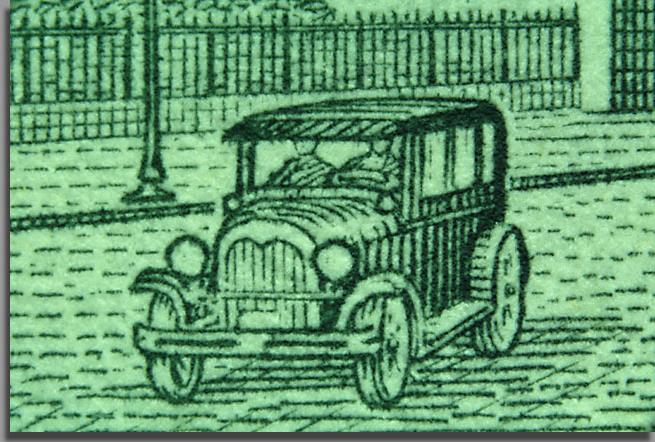
What, then, could my objection possibly be? Well, I'll tell you. I've always loved $10 bills because they used to have some funky looking old cars on the back:

And here's a detail of the most prominent car:

Though many claim that this is a Ford Model T, it isn't; in fact, it isn't any real car, but rather a succesful attempt to make a generic-looking late-twenties car. After all, the Treasury Department isn't in the business of endorsing car companies.

I liked this car a lot, because it must have seemed bold and contemporary-looking in 1929 when it was designed. Then, over the years, it took on a quaint charm, until the 2000 redesign did away with it. I tried to protest by boycotting money, but then I got hungry. When I saw the new redesign a few months ago (wasn't expecting that!) I first thought I accidentally got foreign currency. Then I quickly realized it had been redesigned, and checked the reverse to see if my car was back. It wasn't, damnit.

Here are some unrelated thoughts I had over the past week, none of which developed into something post-worthy:

1. The new Regina Spektor album, "Begin to Hope," which came out this week, is fantastic. Go buy it and find out for yourself. It's a little less consistent than her last album, "Soviet Kitsch," but although the lows are lower, the highs are higher. The production is a bit weird, with heavy use of silly-sounding synthesized strings. This is surprising, since the producer, David Kahne, produced the best albums by Fishbone, the band I was obsessed with in high school. Indeed, I think his production was key to their sound; their later albums, which he didn't produce, are markedly inferior.

2. After years of trying and failing, I'm starting to like Leonard Cohen. Since I'be been thinking so much about singing pronunciation lately, I noticed two things:
a) In the chorus of "So Long, Marianne," he rhymes 'Marianne' and 'began' with 'again.' In my American pronunciation, this is a not too jarring half-rhyme. However, as a Canadian, he naturally pronounces 'again' to rhyme with 'gain.' You can hear him struggling not to pronounce it this way, but when the word crops up in the verse he pronounces it the Canadian way.
b) In "One Of Us Cannot Be Wrong" he pronounces the word "prescription" as "perscription," which is, incidentally, how I pronounce it. Both these examples are interesting to me because I'm working on a theory that, in contrast to the standardized mid-Atlantic popular singing pronunciation scheme I've been posting about, cerebral folk-rockers in the mid sixties opted for a pronunciation scheme that more closely resembled generic Northern colloquial speech. More on this later, maybe.

3. After the fascinating exchange in the comments section of my last post, I'm tempted first of all to post less often and see what other interesting things crop up, and I'm inspired once again to link to this cute flash animation that involves intrusive intrusive /r/ in an otherwise decent imitation of a Chicago-like dialect. For the record, if Homestar Runner winds up taking over your life, don't say I didn't warn you.