A while back I posted about my new hero, the songwriter and keyboardist Billy Preston. Back then I wasn't as web-savvy. What's more, lo, these last five months, the amount of streaming music and video on the web has increased exponentially (okay, perhaps not that much, but try to prove me wrong). Anyways, back then you had to take my word for it that Billy Preston was worthy of worship. Now I can prove it. Check out the following clip from George Harrison's fabled Concert for Bangladesh. Watch it all the way through, if you've got time and patience for it:
Billy Preston - That's The Way God Planned It
Now that's an amazing performance, you must admit, even if gospel-infused R&B isn't your cup of proverbial tea (Get it? infused? tea? Boy, sleep deprivation is a wild ride!) I have to say, that performance puts the fear of God in this atheist's soul, not that I believe I have one.
Thursday, March 30, 2006

Wednesday, March 29, 2006

Tuesday, March 28, 2006
The Hinsdale-Wheaton Isogloss Bundle
A few weeks or maybe months ago there was some discussion over at Language Log about the complex intersection of the terms "blog," "blawg" and the low-back merger, which linguists call the "cot/caught" merger, and which Argotnaut calls the "hottie/haughty" merger, a merger I've touched on here. The complexity I wasn't aware of -- well, one of many -- is that people who distinguish between these vowels don't always agree on which word has which vowel. For instance, the vowels in "Chicago" and "sausage" for me are "caught" vowels, whereas for others they are "cot" vowels.
Thus, when in a recent email my mother coined the term "blahg" -- get it? I had to find out how she pronounced it, so I asked her, ever so innocently (This blog is a secret: don't tell my parents! Or my adviser!) if "blahg" and "blog" are pronounced the same. She said they were.
Does this mean she has the "cot/caught" merger? No, and I can attest she doesn't, nor should she; she's from Barrington, Illinois, what was a small town when she lived there and is now an outer northwest suburb of Chicago, definitively in unmerged territory. Rather, this means that "blog" and, implicitly, "log" in her dialect have the "cot" vowel. Me, I would definitely pronounce "blahg" and "blog" differently -- "log" and "blog" are "caught" words for me.
Thus I propose that there is an isogloss dividing the western suburbs of Chicago from the rest of the Chicagoland area, which I will call the "blahg/blog" isogloss. Since I am making up facts, I will further suggest that this isogloss is in the same place as the one delimiting the occurrence of positive 'anymore' in Chicagoland. So we see that there is actually an isogloss bundle running roughly (why not?) along I-294, or maybe the Cook/Du Page county line. This isogloss reflects cultural differences and historic settlement patterns, though I can't say which ones. Boy, making up facts is fun. Here's a map:
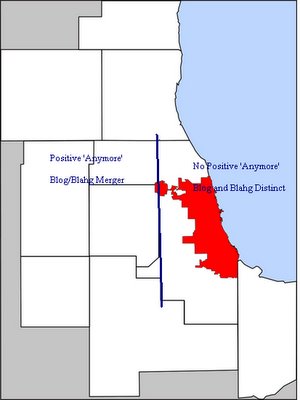
How's that for armchair dialectology? The closest thing to data behind this map comes from my Positive 'Anymore' Unscientific Survey Experiment (PAUSE), which clearly shows that people from the city of Chicago and the inner suburbs think they don't use positive 'anymore' and in fact probably don't, though anymore it's hard to tell.
Thus, when in a recent email my mother coined the term "blahg" -- get it? I had to find out how she pronounced it, so I asked her, ever so innocently (This blog is a secret: don't tell my parents! Or my adviser!) if "blahg" and "blog" are pronounced the same. She said they were.
Does this mean she has the "cot/caught" merger? No, and I can attest she doesn't, nor should she; she's from Barrington, Illinois, what was a small town when she lived there and is now an outer northwest suburb of Chicago, definitively in unmerged territory. Rather, this means that "blog" and, implicitly, "log" in her dialect have the "cot" vowel. Me, I would definitely pronounce "blahg" and "blog" differently -- "log" and "blog" are "caught" words for me.
Thus I propose that there is an isogloss dividing the western suburbs of Chicago from the rest of the Chicagoland area, which I will call the "blahg/blog" isogloss. Since I am making up facts, I will further suggest that this isogloss is in the same place as the one delimiting the occurrence of positive 'anymore' in Chicagoland. So we see that there is actually an isogloss bundle running roughly (why not?) along I-294, or maybe the Cook/Du Page county line. This isogloss reflects cultural differences and historic settlement patterns, though I can't say which ones. Boy, making up facts is fun. Here's a map:
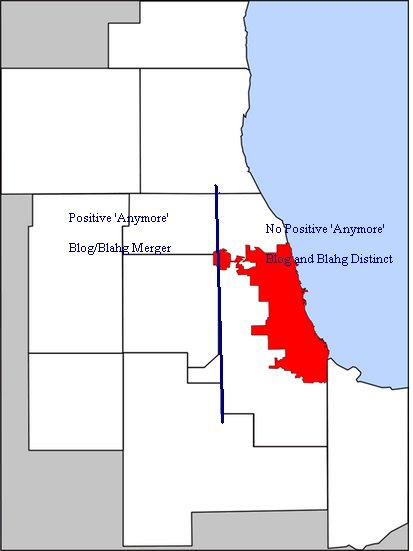
How's that for armchair dialectology? The closest thing to data behind this map comes from my Positive 'Anymore' Unscientific Survey Experiment (PAUSE), which clearly shows that people from the city of Chicago and the inner suburbs think they don't use positive 'anymore' and in fact probably don't, though anymore it's hard to tell.
Sunday, March 26, 2006
Ringe Range Rouzi
One of the coolest things I've found recently is a Hasidic online forum in Yiddish called "kinderishe geredekhts" - chilren's sayings. People write in, posting their memories of things they remember saying as children. Personally, I love children's sayings - it's a bit of real, vibrant folklore that we've all participated in firsthand. Sometimes children's sayings can be surprising. For instance, my wife, attending to a one-room schoolhouse (really) that was fifteen miles from the nearest post office, learned the same bit of doggerel that I did on the South Side of Chicago:
Monchichi monchichi
I can play Atari
Monchichi monchichi
I can do karate
Monchichi monchichi
Oops I'm sorry
How and why did this piece of nonsense spread so widely? I don't know, but it did. Weird, no? A lot of the Hasidic children's sayings are equally strange, but what fascinates me most is the interplay between Eastern European and American elements. Some of the sayings I know from scholarly studies of Yiddish children's sayings, others are English ones I knew growing up. Then there is the following:
רינגע ראנגע ראוזי פאקע פאלע פאוזי, עשעס עשעס ווי אלל פאל דאון
"Ringe range rouzi pake fole pouzi, eshes eshes vi all fal daun."
Pretty darn cool.
Even cooler is the ensuing discussion. The poster asks if anyone has heard the rumor that this has to do with idolatry. Someone else writes in to say that he read in "Mallos" (a Hasidic magazine) that this rhyme comes from "the church," and that the "falling down" at the end has to do with bowing down, a big taboo in Judaism, such a big no-no that the poster adds an acronym רח''ל meaning, roughly, 'God forbid' - for merely having mentioned bowing down. Someone else writes
This prompts someone to post a link to Snopes where they debunk the story that "Ring Around the Rosie" has anything to do with any plague.
A heck of a journey, all told. From suspicious rumors of idolatry to widespread urban legends to Snopes. All within a week. This is the revolution the internet is causing in the Hasidic world - an instant acceleration to light speed. And we get to watch.
Monchichi monchichi
I can play Atari
Monchichi monchichi
I can do karate
Monchichi monchichi
Oops I'm sorry
How and why did this piece of nonsense spread so widely? I don't know, but it did. Weird, no? A lot of the Hasidic children's sayings are equally strange, but what fascinates me most is the interplay between Eastern European and American elements. Some of the sayings I know from scholarly studies of Yiddish children's sayings, others are English ones I knew growing up. Then there is the following:
רינגע ראנגע ראוזי פאקע פאלע פאוזי, עשעס עשעס ווי אלל פאל דאון
"Ringe range rouzi pake fole pouzi, eshes eshes vi all fal daun."
Pretty darn cool.
Even cooler is the ensuing discussion. The poster asks if anyone has heard the rumor that this has to do with idolatry. Someone else writes in to say that he read in "Mallos" (a Hasidic magazine) that this rhyme comes from "the church," and that the "falling down" at the end has to do with bowing down, a big taboo in Judaism, such a big no-no that the poster adds an acronym רח''ל meaning, roughly, 'God forbid' - for merely having mentioned bowing down. Someone else writes
The legend that 'Ring a ring a rozi" has to do with idolatry is sheer idiocy. Somebody just brought me a pamphlet from England that he picked up in one of the tourism places, and it just says that a few hundred years ago there was a plague in England that begins as a rash on the hands shaped like a round rose etc. and the remedy was to put ash on it, and if you didn't you would fall down dead.
This prompts someone to post a link to Snopes where they debunk the story that "Ring Around the Rosie" has anything to do with any plague.
A heck of a journey, all told. From suspicious rumors of idolatry to widespread urban legends to Snopes. All within a week. This is the revolution the internet is causing in the Hasidic world - an instant acceleration to light speed. And we get to watch.
Friday, March 24, 2006
You Want I Should Grow A Beard?
One of my favorite Yiddishisms in English is the "I want you should" construction, a direct calque from Yiddish. I like it because it in part because it is so well-known, yet few know it's from Yiddish. My students always get a kick out of it (and yesterday they got a kick out of learning that "I don't have what to wear" is also a calque from Yiddish), and I get a kick out of hearing people use it, never suspecting it's a Yiddishism.
Through a roundabout series of events, I found myself reading the letter that inspired Abraham Lincoln to grow a beard -- you know the one, that an 11 year old girl (Grace Bedell from Westfield NY, not far from Erie PA) wrote -- and was struck by two things in the first two sentences:
On the other hand...
Googling "I want you should" reveals that this construction existed in English long before contact with Yiddish. Weird, no? Still, though, I'm convinced its current widespread use is due to Yiddish.
Through a roundabout series of events, I found myself reading the letter that inspired Abraham Lincoln to grow a beard -- you know the one, that an 11 year old girl (Grace Bedell from Westfield NY, not far from Erie PA) wrote -- and was struck by two things in the first two sentences:
My father has just home from the fair and brought home your picture and Mr. Hamlin's. I am a little girl only eleven years old, but want you should be President of the United States very much. (Italics mine)What is going on here? Are these archaisms? Mistakes? Most of the ghits for "has just home" refer to this letter, which leads me to suspect she accidentally left out the word "come" or "returned." Oddly enough, though, this too could be explained as a calque from Yiddish, if it weren't an absurd possibility.
On the other hand...
Googling "I want you should" reveals that this construction existed in English long before contact with Yiddish. Weird, no? Still, though, I'm convinced its current widespread use is due to Yiddish.
Thursday, March 23, 2006
A Slight Flaw
Commenter AJD raises an important cautionary note about the premise of my Unscientific Positive 'Anymore' Survey (UPAS), namely that many people who use positive 'anymore' insist they don't. I was aware of this fact in the back of my mind (I allude to it in my very first post), and while I think this adds to the unscientificness of my survey, it doesn't ruin it outright. Since I'm interested in finding where positive 'anymore' isn't, I don't really have another viable option than to flat-out ask people if they think it sounds reasonable, and take a 'no' as an indication that they don't use it, even though they might. What else am I going to do, an exhaustive corpus study? Please - that's for people who want meaningful results!
Anyways, the data is trickling in, so I've got that going for me, which is nice. While I'm typing, I wanted to mention a phenomenon I've only noticed in the last few years (not that that entails it's a recent phenomenon) that puzzles me slightly. Some people say things like "Since I am six years old" to mean "Ever since I was six years old," not "Because I am currently six years old." I feel like I've heard this both in Chicago and New York, and for a while I seemed to hear it only from African Americans, but then I heard it from non-African Americans too, but overall I haven't encountered it often enough to get a sense for its respective geographic, social and economic distribution. Is there a term for this? Has it been studied? Is it even noteworthy? I think it's interesting, especially since English is somewhat idiosyncratic when it comes to sequence of tense. In any case, I'd like to know more.
Anyways, the data is trickling in, so I've got that going for me, which is nice. While I'm typing, I wanted to mention a phenomenon I've only noticed in the last few years (not that that entails it's a recent phenomenon) that puzzles me slightly. Some people say things like "Since I am six years old" to mean "Ever since I was six years old," not "Because I am currently six years old." I feel like I've heard this both in Chicago and New York, and for a while I seemed to hear it only from African Americans, but then I heard it from non-African Americans too, but overall I haven't encountered it often enough to get a sense for its respective geographic, social and economic distribution. Is there a term for this? Has it been studied? Is it even noteworthy? I think it's interesting, especially since English is somewhat idiosyncratic when it comes to sequence of tense. In any case, I'd like to know more.
Subscribe to:
Posts (Atom)