Oregonian: So I was just talking to Dawn...
Chicagoan: Wait -- who's Don?
The Oregonian was my long-suffering wife, and the Chicagoan was her long-suffering supervisor. Incidentally, this selfsame supervisor has already made an appearance on these very pages as the native of Wheaton (an outer suburb of Chicago) who frequently uses positive anymore in her speech. The other day I remarked to her that her use of this construction was, well, remarkable, and she told me that it is actually an affectation for her -- she heard someone use positive anymore at some point in her childhood (she forgets who and when), was impressed by it, and decided to adopt it.
How 'bout that?
Thursday, May 18, 2006

Wednesday, May 17, 2006
Saturday, May 13, 2006
New Names For The Cot/Caught Merger
So Argotnaut gave over Frinkenstein's suggestion "hottie/haughty." This got me thinking about other minimal pairs collapsed by the low-back merger. Soon I had a large and unwieldy list, so I decided to offer some of the pairs I like the most, since I think we all agree that the name "cot/caught" must go. In my opinion none are as good as hottie/haughty, but they are still worth listing, if only to give me something amusing to post about. Here they are:
Otto/auto
Gotti/gaudy
bobble/bauble
cod/cawed
lager/logger
pod/pawed
yon/yawn
cock/caulk
I hesitated before adding the last one, just because I fear that as a result people will get to this blog by searching for... well, something they won't find here. Speaking of strange things people reach this blog searching for, I've had three (I think) visitors who googled 'should I grow a beard' - a weird thing to google, and a weirder thing for me to be on the first page of results for, IMHO. AFAIK. ROFL? pWn3d? I'll stop now.
Speaking of caulk, I spent a summer working for the physical plant of my college in Portland, Oregon, during which time I was struck by how funny my co-workers found the word "caulk," which seemed juvenile to me, but now I realize that if I had the low-back merger like they did I would have found it funny too. Not that it isn't juvenile.
So my northwesterner wife has the lager/logger merger - that seems like an appropriate way to describe it in the Pacific Northwest - but I've found that it's only partial. I realized, for instance that she says "awesome" the way I do, not /ah/some, as I expected, even though she insists she 'can't say' "haughty" the way I do. So I asked her about this, and she says that she's 'saying the w,' which makes sense. I tried out cod/cawed on her, but it was merged, though, interestingly enough, 'caw' came out /kɔ/. Is it possible that there is a historical explanation for this? I don't know enough to guess, though usually that doesn't stop me.
Otto/auto
Gotti/gaudy
bobble/bauble
cod/cawed
lager/logger
pod/pawed
yon/yawn
cock/caulk
I hesitated before adding the last one, just because I fear that as a result people will get to this blog by searching for... well, something they won't find here. Speaking of strange things people reach this blog searching for, I've had three (I think) visitors who googled 'should I grow a beard' - a weird thing to google, and a weirder thing for me to be on the first page of results for, IMHO. AFAIK. ROFL? pWn3d? I'll stop now.
Speaking of caulk, I spent a summer working for the physical plant of my college in Portland, Oregon, during which time I was struck by how funny my co-workers found the word "caulk," which seemed juvenile to me, but now I realize that if I had the low-back merger like they did I would have found it funny too. Not that it isn't juvenile.
So my northwesterner wife has the lager/logger merger - that seems like an appropriate way to describe it in the Pacific Northwest - but I've found that it's only partial. I realized, for instance that she says "awesome" the way I do, not /ah/some, as I expected, even though she insists she 'can't say' "haughty" the way I do. So I asked her about this, and she says that she's 'saying the w,' which makes sense. I tried out cod/cawed on her, but it was merged, though, interestingly enough, 'caw' came out /kɔ/. Is it possible that there is a historical explanation for this? I don't know enough to guess, though usually that doesn't stop me.
Wednesday, May 10, 2006
Historic Preservation

When I first got interested in architecture I was something of an extremist when it came to preservation; any old structure that got demolished broke my heart. I think that this was due to the fact that I lived in Portland, Oregon, a city that, like many cities in the west, has a relatively small number of old structures. I remember when an unremarkable late nineteenth century brick warehouse across the street from my apartment was demolished how I felt like it was almost a criminal act. Over the years I've gotten less rabid, but it still breaks my heart to read stories like this one about the demolition of historic homes in Kenilworth, Illinois.
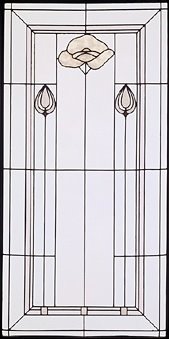
Kenilworth contains the greatest concentration of houses by George Maher, the most distinctive of the architects associated with the Prairie School. Maher's signature was what he called "motif-rhythm" - using simple geometric shapes, usually segmental arches and poppies, to create thematic unity in a building. Here are some examples of his
 work:
work:Armchair, c. 1912

 The Rath House, 1907
Chicago
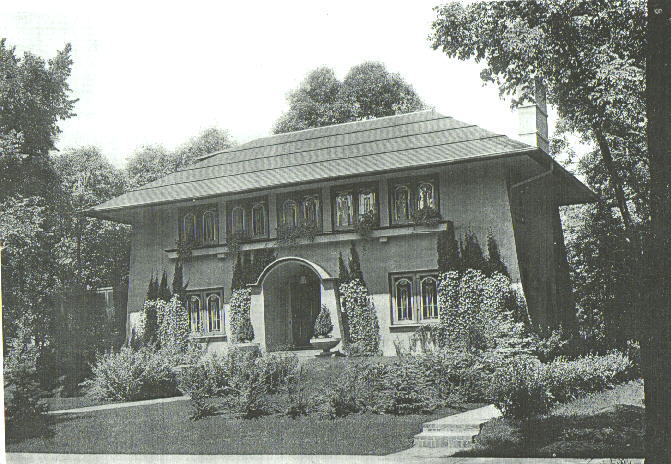
Schultz House, 1907
Winnetka IL
My childhood home was in fact a Maher-designed apartment building from 1908, and those segmental arches sure look homey to me. That chair would have looked great in our apartment, but, like with most Prairie School buildings, the interior was gutted in the 1950s, and all the custom furniture and most of the decoration (stained glass, stenciling, mosaic fireplace) vanished.
That was depressing. If you need something to cheer you up, read this story about a tortoise and a hippo who are friends.

Sunday, May 07, 2006
Stupifany #2
The title and refrain of Madonna's 1986 hit "Papa Don't Preach" is in the imperative mood, not the indicative. That is, "Papa, don't preach." And I never realized that until this morning.
(What's a stupifany?)
(What's a stupifany?)
Friday, May 05, 2006
Sterling Kosher Salt
The other day Ben Zimmer hipped me to the Yiddish Radio Project, which I knew about from the NPR series four years ago. Back then I was, to be frank, underwhelmed by the series, which I felt dwelt (!) too long on English language materials. What little Yiddish they did play they talked over. In any case, I'm very glad Ben drew my attention to the Yiddish Radio Project again, because in the interim they've assembled quite a collection of online streaming Yiddish audio, much of it with simultaneous scrolling English translations, which aren't error-free, but are idiomatic and often clever.
My favorite thing I've found so far is this series of 'man-on-the-street' interviews (most of the interviewees are actually women, and they're inside a store). What I really love hearing, though, is authentic American Yiddish, something I've read about a lot, and even read a lot of, but only heard from very elderly informants. This was the Yiddish that developed in America during and after the 'great migration', that is, 1881-1924. It was spoken predominantly by immigrants, though many of the children of immigrants were capable of understanding it, and sometimes speaking it, though they were invariably more comfortable with English. Incidentally, this is a common pattern with immigrant languages in America, though with Yiddish people ascribe this trend to a particular overeagerness on the part of American Jews to assimilate.
American Yiddish is notable for three things: 1) promiscuity with features from different dialects, 2) 'Daytshmerish,' or Germanizing tendencies, and 3) significant borrowing from English. One could condemn each of these features (many do) but I see them as perfectly natural developments. All three features are readily discernable in the clip above, particularly the first - it is sometimes difficult to identify what is the underlying dialect of each speaker, since each speaker exhibits features from a variety of dialects.
I would have thought of this as strange - these are all European-born Yiddish speakers who, prior to immigration, undoubtedly spoke the undiluted dialect of their hometown, so why should they suddenly pick up features from the various dialects they encountered in America?
As I said, I would have thought of this as strange, were it not that a recent experience makes me think that this is in fact perfectly natural. My brother in law has been living in New Zealand for a few years now, and suddenly has picked up a New Zealand accent. Again, I would have thought of this as an affectation, but when he heard a recording of himself, he was shocked.
So why is it, then, that after ten years of not living in Chicago people can still instantly guess where I'm from?
My favorite thing I've found so far is this series of 'man-on-the-street' interviews (most of the interviewees are actually women, and they're inside a store). What I really love hearing, though, is authentic American Yiddish, something I've read about a lot, and even read a lot of, but only heard from very elderly informants. This was the Yiddish that developed in America during and after the 'great migration', that is, 1881-1924. It was spoken predominantly by immigrants, though many of the children of immigrants were capable of understanding it, and sometimes speaking it, though they were invariably more comfortable with English. Incidentally, this is a common pattern with immigrant languages in America, though with Yiddish people ascribe this trend to a particular overeagerness on the part of American Jews to assimilate.
American Yiddish is notable for three things: 1) promiscuity with features from different dialects, 2) 'Daytshmerish,' or Germanizing tendencies, and 3) significant borrowing from English. One could condemn each of these features (many do) but I see them as perfectly natural developments. All three features are readily discernable in the clip above, particularly the first - it is sometimes difficult to identify what is the underlying dialect of each speaker, since each speaker exhibits features from a variety of dialects.
I would have thought of this as strange - these are all European-born Yiddish speakers who, prior to immigration, undoubtedly spoke the undiluted dialect of their hometown, so why should they suddenly pick up features from the various dialects they encountered in America?
As I said, I would have thought of this as strange, were it not that a recent experience makes me think that this is in fact perfectly natural. My brother in law has been living in New Zealand for a few years now, and suddenly has picked up a New Zealand accent. Again, I would have thought of this as an affectation, but when he heard a recording of himself, he was shocked.
So why is it, then, that after ten years of not living in Chicago people can still instantly guess where I'm from?
Tuesday, May 02, 2006
Miracle Drug
There's a medecine on the market for rheumatoid arthritis called Humira. According to the leaflet, it is pronounced "hu-mare-ah." How can the letter 'i' make the sound /e/? This stumped me for a while (and it seems I was not the only stumped one). The other day, though, I came up with a possible explanation for this counterintuituve pronunciation, an explanation of which I am fond, though it raises its own problem.
It occurred to me that this is a pun on the word "miracle," which it further occurred to me I pronounce "mare-acle." Finally it occurred to me to wonder why I pronounce this word this way. I'm still wondering, but now I suspect I'm not the only one who does so, despite what my wife says. A bit of online research turned up the following inconclusive maps from Bert Vaux's survey. I'm not even sure if any of the options apply to me; the closest is /ɛ/, but because of tense-lax mergers I can't have that vowel before an /r/.
Thus the wordplay behind the "hu-mare-ah" is obscured by the limited occurrence of the correspondind pronunciation of 'miracle.' The implication that Humira is a miracle drug may be hyperbolic, but it belongs to a new class of immunological drugs that are revolutionizing the treatment of autoimmune diseases.
Speaking of autoimmune diseases, in an article in last week's New Yorker Ben McGrath described the decrepitude of an elderly mob turncoat thusly:
In the interest of disclosure I must disclose that I have Raynaud's disease, and only hope that some day a treatment may be found, not for my sake, but for my children's, as this is a genetic condition, and both I and my wife suffer from this truly debilitating disease.
It occurred to me that this is a pun on the word "miracle," which it further occurred to me I pronounce "mare-acle." Finally it occurred to me to wonder why I pronounce this word this way. I'm still wondering, but now I suspect I'm not the only one who does so, despite what my wife says. A bit of online research turned up the following inconclusive maps from Bert Vaux's survey. I'm not even sure if any of the options apply to me; the closest is /ɛ/, but because of tense-lax mergers I can't have that vowel before an /r/.
Thus the wordplay behind the "hu-mare-ah" is obscured by the limited occurrence of the correspondind pronunciation of 'miracle.' The implication that Humira is a miracle drug may be hyperbolic, but it belongs to a new class of immunological drugs that are revolutionizing the treatment of autoimmune diseases.
Speaking of autoimmune diseases, in an article in last week's New Yorker Ben McGrath described the decrepitude of an elderly mob turncoat thusly:
He suffered his second minor stroke and third detached retina. He also endured high blood pressure, poor hearing, arthritis, prostate cancer, and Raynaud's disease.In case you are not familiar with this last disease (which is an autoimmune disease), here is how Wikipedia describes it:
Poor guy -- when it's cold his fingers turn blue.
- When exposed to cold temperatures, the oxygen supply to the fingertips, toes, and earlobes of Raynaud's disease patients are reduced and the skin color turn pale or white (called pallor) and become cold and numb.
- When the oxygen supply is depleted, the skin colour turns blue (called cyanosis).
- These events are episodic and when the episode subsides, or the area is warmed, blood returns to the area and the skin colour turns red (rubor) and then back to normal, often accompanied by swelling and tingling. These symptoms are thought to be due to reactive hyperemias of the areas deprived of blood flow.
All three colour changes are present in classic Raynaud's disease. However, some patients do not see all of the colour changes in all outbreaks of this condition.
In the interest of disclosure I must disclose that I have Raynaud's disease, and only hope that some day a treatment may be found, not for my sake, but for my children's, as this is a genetic condition, and both I and my wife suffer from this truly debilitating disease.
Subscribe to:
Posts (Atom)