Then I left the comforts of Chicago for college and was confronted by a dormitory full of Californians and Northeasterners who would howl with derision and displeasure any time I said "pop." Suddenly it occured to me that there was something to this matter. I asked around a little, discovered the (to me) surprising Southern use of "coke" as a generic term, as in "7-Up is my favorite kind of coke." Upon further reflection I realized that while "soda" struck me as a neutral term, one that I would never notice someone else using, I would never utter it myself. Ultimately I formed a more-or-less accurate mental map, with "coke" in the South, "soda" in the Northeast and California, and "pop" in the Midwest and Pacific Northwest.
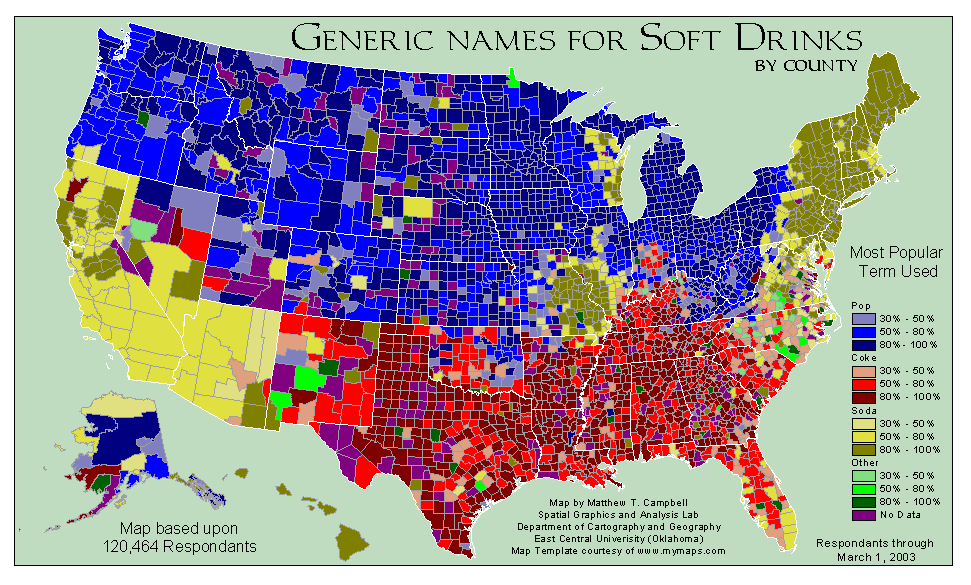
Fast forward to last year, when I found the following map, (which the Chocolate Lady mentioned in a recent comment):
Beautiful, isn't it? I should mention that maps are a lifelong passion; give me an atlas and I can stay happy and entertained for hours.
Why do I love this map so much? Mostly because the data is so clearly presented; you don't need any isoglosses artificially thrown in, especially in the East where population is dense and counties small. The quality and clarity of the data is all the more remarkable given the incredibly scientific sampling method: the data comes from a website that had a form for visitors to fill out. That's it. Such beauty from such humble origins. What this shows is that this is an entrenched lexical difference in American vernacular speech, and moreover one that involves frequently used words -- in classical American dialectology, the reliance upon obscure terms borders on the ridiculous: "What do you call an oblong barrel for fermenting barley in -- a jim-wheelie [That's the Midland term] or a huck-pot [the Southern one]?" Okay, I made that up. Anyways, whoever you are, wherever you're from, if you're American you use a word for sweet carbonated non-alcoholic beverages that reflects where you are from more than anything else.
A few remarks about the map itself. First off, the distribution of "coke" is an amazingly good indicator of southernness. Not only does it skip over the heart of Appalachia (West Virginia, Eastern Kentucky), but it includes the "Hoosier apex," that is, the part of southern Indiana that Hans Kurath considered a northerly outpost of Southern dialect. Furthermore, Maryland's Eastern Shore, the most culturally Southern part of the state is an isolated "coke" area. In contrast, the pop/soda isogloss does not fit neatly with any cultural isoglosses I know of. And as a pop-sayer myself, I look with pride on the grand stretch of blue from western New York all the way to Seattle.
Notice also the sort of indeterminate area in North Carolina where "soda" and "coke" meet. This is due to two different local terms, "dope" and "drink." I think this proves what I suspect Walt Wolfram of believing, that North Carolina is the weirdest part of the country, dialectologically speaking. That the Boston area has a lower percentage of "soda" sayers is due to another localism, "tonic." I asked a Bostonian friend if he knew the term, and he said, "Sure. Gym teachers say it." I think that's an interesting sociological observation right there. For my part, I always associated a strong Chicago dialect with car-salesmen. Though now that I think about it, gym teachers weren't far behind. I always thought that Coach Z talked exactly like a coach should. Then I realized he was supposed to have a Chicago accent.
Also noteworthy are the two "soda" islands in the Midwest, one in eastern Wisconsin and another in a large area roughly centered on St. Louis. I can only speculate about why they exist, but I can relate that people from these areas have told me that for them "soda" is a prestigious term that they associate with urbanites, while hicks say "pop." This makes sense, since the eastern Missouri/southwestern Illinois soda island radiates out from a major city (St. Louis), and eastern Wisconsin one divides the more urban, industrial eastern part of the state from the rural, agrarian west.
Finally, I think I now understand why I failed to see any real distinction between "soda" and "pop." While I was from the heart of the "pop" zone, I was exposed to mass American culture, which is produced in the "soda" saying lands of California and the Northeast. Thus "soda" seemed so acceptable to me that I didn't even know I didn't say it.
A footnote about Coach Z: although his Chicago dialect (or maybe just Inland Northern, though his dental fricatives do border on plosives) is not bad -- certainly not much worse than that of the Superfans -- the feature of his speech that gets the most attention is an exaggeration of a Midland one.